By Joey Roulette
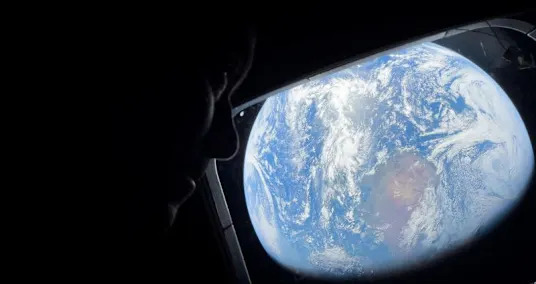
HOUSTON, Texas April 6 (Reuters) - The four astronauts of NASA's Artemis II mission reached the furthest point that any human has been from Earth on Monday, cruising along a path in the Moon's gravitational sphere of influence that will soon take them over the shadowed, lunar far side.
The Artemis II crew, flying in their Orion capsule since launching from Florida last week, awoke around 10:50 a.m. ET for their sixth flight day to a recorded message from late Apollo 8 and 13 astronaut Jim Lovell.
"Welcome to my old neighborhood," said Lovell, who died last year at 97. "It's a historic day, and I know how busy you'll be, but don't forget to enjoy the view... good luck and godspeed."
NASA astronauts Reid Wiseman, Victor Glover and Christina Koch and Canadian astronaut Jeremy Hansen later on Monday were due to reach their maximum distance from Earth of roughly 252,760 miles, some 4,105 miles (6,606 km) beyond the record held by Lovell and his Apollo 13 crew for 56 years.
Next they will sail around the moon's far side, witnessing it from roughly 4,000 miles above its darkened surface as it eclipses what will appear to be a basketball-sized Earth in the distant background.
The milestone is a climactic point in the nearly 10-day Artemis II mission, the first crewed test flight of NASA's Artemis program.
The multibillion-dollar series of missions aims to return astronauts to the moon's surface by 2028 before China, and establish a long-term U.S. presence there over the next decade, building a moon base that would serve as a proving ground for potential future missions to Mars.
The lunar flyby will plunge the crew into darkness and brief communications blackouts as the moon blocks them from NASA's Deep Space Network, a global array of massive radio communications antennas the agency has been using to talk to the crew.
The flyby will last about six hours, during which the astronauts will use professional cameras to take detailed photos of the moon through Orion's window, showing a rare and scientifically valuable vantage point of sunlight filtering around its edges.
The crew will also have the chance to photograph a rare moment in which their home planet, dwarfed by their record-breaking distance in space, will set and rise with the lunar horizon as they swing around, a celestial remix of a moonrise seen from Earth.
A team of dozens of lunar scientists positioned in the Science Evaluation Room at NASA's Johnson Space Center in Houston will be taking notes as the astronauts, who studied an array of lunar phenomena as part of mission training, describe their view in real time.
(Reporting by Joey Roulette; Editing by Don Durfee, Aurora Ellis and Bill Berkrot)
latest_posts
- 1
 Miss 'Stranger Things' already? Here's how you can get your Upside Down fix in 2026 with spinoffs, games and more
 - 2Figure out How to Acquire Rewarding Open Record Rewards
- 3The largest sun of 2026 rises today as Earth draws closest to our parent star
- 4Brazil judge orders government to add JBS subsidiary to 'dirty list' for slavery
- 5One dead, six wounded in various crime-related shootings in Israel over the weekend


- Mount Everest Climbers 'Poisoned' by Guides Prompting Mass Helicopter Rescues in $20 Million Insurance Fraud Scheme, Police Say
- Accor signs agreement to transform El Gouna resort as Sofitel
- ABC News' Sam Champion opens up about recent health scare
- The most effective method to Execute a Lung-Solid Eating routine After a Cellular breakdown in the lungs Finding
- Sweet Taste? Candy Fulfills You
- 6 Fun Urban areas For Seniors To Travel
- A definitive Handbook for Securities exchange Money management
- A Colombian city swaps iconic horse buggies for electric carriages amid animal welfare concerns
- How Seniors Can Use Refunds and Motivators to Purchase a Hyundai Ioniq EV