When you buy through links on our articles, Future and its syndication partners may earn a commission.

NASA's X-ray spacecraft XRISM, which stands for X-ray Imaging and Spectroscopy Mission, has clocked how fast winds are ripping from a distant galaxy bursting with star formation.
It would appear these winds travel at an incredible 2 million miles per hour (3.21 million kilometers per hour).
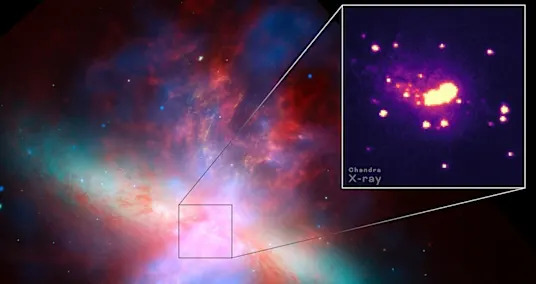
The superheated gas from this galaxy, Messier 82 (M82), flows from a region of intense stellar activity at the galaxy's heart. M82 is located around 12 million light-years away from us in the northern constellation Ursa Major and classified as a "starburst galaxy" because it is forming stars 10 times as rapidly as the Milky Way does.
"The classic model of starburst galaxies like M82 suggests that shock waves from star formation and supernovas near the center heat gas, kick-starting a powerful wind," team member Erin Boettcher, of the University of Maryland, College Park, and NASA’s Goddard Space Flight Center in Greenbelt, Maryland, said in a statement. "Prior to XRISM, though, we didn't have the ability to measure the velocities needed to test that hypothesis. Now we see the gas moving even faster than some models predict, more than enough to drive the wind all the way to the edge of the galaxy."
Boettcher measured the speed of these galactic winds using the XRISM (pronounced "crism") spacecraft's Resolve instrument.
Cigar galaxy has smoking hot winds
Also known as the Cigar Galaxy, M82 is known for its cool winds composed of vast amounts of gas and dust that stretch out for around 40,000 light-years. These winds have been observed with a wealth of space telescopes, including the Hubble Space Telescope, the James Webb Space Telescope (JWST), Chandra and Spitzer.
The aim of this team's investigation was to connect these massive outflows of matter with stellar activity in M82. This includes discovering the effect of high-speed particles called cosmic rays on the winds of the galaxy. This is important because researchers suggest the same phenomenon that blows these winds also launches cosmic rays and believe they may be the main source of pressure pushing the outflows.
XRISM measured the 2-million-mph speed of these winds by observing X-ray radiation being emitted by superheated iron at the heart of M82. This also revealed a temperature of 45 million degrees Fahrenheit (25 million degrees Celsius) at M82's galactic center, with this heat generating pressure that pushes the winds outward, from high pressure to low pressure, just like the movement of winds through Earth's atmosphere.

These winds aren't just extraordinary for their speeds and initial temperatures, but also for the amount of material they shunt. The team found the center of M82 expels the equivalent of seven suns each year. That poses something of a puzzle for astronomers.
"If the wind blows steadily at the speed we've measured, then we think it can power the larger, cooler wind by driving out four solar masses of gas a year. But XRISM tells us much more gas is moving outward," XRISM Member Edmund Hodges-Kluck said in the statement. "Where do the three extra solar masses go? Do they escape out of the galaxy as hot gas some other way? We don't know."
XRISM will continue to observe M82, potentially helping scientists solve this puzzle while simultaneously building better models of starburst galaxies.
"Some of our early models of starburst galaxies were developed in the 1980s, and we're finally able to test them in ways that weren’t possible before XRISM," team member Skylar Grayson of Arizona State University, said in the statement. "It provides opportunities to figure out why the model might not be capturing everything that’s going on in the real universe."
The team's findings were published on Wednesday (March 25) in the journal Nature.
latest_posts
- 1
 Cyber Monday Paramount+ deal: Save 50% and stream these buzzy Taylor Sheridan shows
 - 2From Overpowered to Coordinated: Individual Accounts of Cleaning up
- 3Step by step instructions to Choose the Right Internet based Degree Program for Your Future
- 4Top Smoothie Flavor: What's Your Mix?
- 5The most effective method to Decide the Best Auto Crash Attorney for Your Lawful Necessities





- Eight arrested in joint Scotland and Spain gang raids
- Presenting Nintendo's New Pastel Bliss Con Tones for Switch Gamers: 3 Smart Choices
- The most effective method to Explore Moral Situations in Brain research with Your Certification
- Wisconsin judge sends Slender Man attacker back to mental health institution after group home escape
- Dominating the Art of Composing: Creator Bits of knowledge
- EU-funded BioSupPack project turns brewery waste into bioplastics
- Everyone knows F1 is for the girls. I wandered into the Las Vegas desert to find out why.
- Sophie Kinsella, 'Confessions of a Shopaholic' author, dies at 55 after battle with cancer
- Sources: IDF does not actually know how many ballistic missiles Iran has left